

There’s a question I get asked often, especially by pharma and medtech founders who are putting together their first marketing budgets: “Do we really need a 3d medical animation company, or can we just work with any good animation studio in India?”
I understand why they ask. On the surface, animation is animation. You have a brief, a script, someone brings it to life in 3D. How different can it really be?
Very different, as it turns out. And the difference matters more than most people realise until something goes wrong — at a medical conference, in front of an investor, or worse, in a regulatory review.
General Animation vs. Medical Animation: Not the Same Game
A talented generalist animation studio in India can do extraordinary things. Product launches, architectural walkthroughs, brand films, gaming cinematics — they have the craft down to a tee. But when you ask that same studio to animate a mechanism of action for a wound-healing biopolymer, or visualise how a surgical implant interacts with the periosteum, you’re not just asking them to be creative. You’re NEED them to be scientifically accurate.
That is an entirely different skill set.
In medical animation, every visual decision carries clinical weight. The angle at which a catheter enters a vessel. The sequencing of immune cell recruitment during inflammation. The anatomical proportions of the heart during a valvuloplasty procedure. If any of these are wrong — even visually convincing but biologically incorrect — the animation fails to communicate, and more dangerously, actively misinforms.
A 3D medical animation studio in India that works exclusively in the healthcare and life sciences space builds institutional knowledge that a generalist simply doesn’t have. Animators who have spent years working on pharma MOAs, surgical simulations, and patient education content have internalised a vocabulary — cellular biology, device mechanics, tissue behaviour — that shapes every decision they make, from lighting choices to camera movement to timing.
This is not something that can be covered in a brief. A thorough script doesn’t compensate for an animator who doesn’t understand what a fibroblast looks like or how it moves. The gap between looking medical and being medically correct is enormous, and only becomes visible to people who know what they’re looking at — which is precisely your audience.
A Wound Healing Animation Example: When Accuracy Is the Entire Point
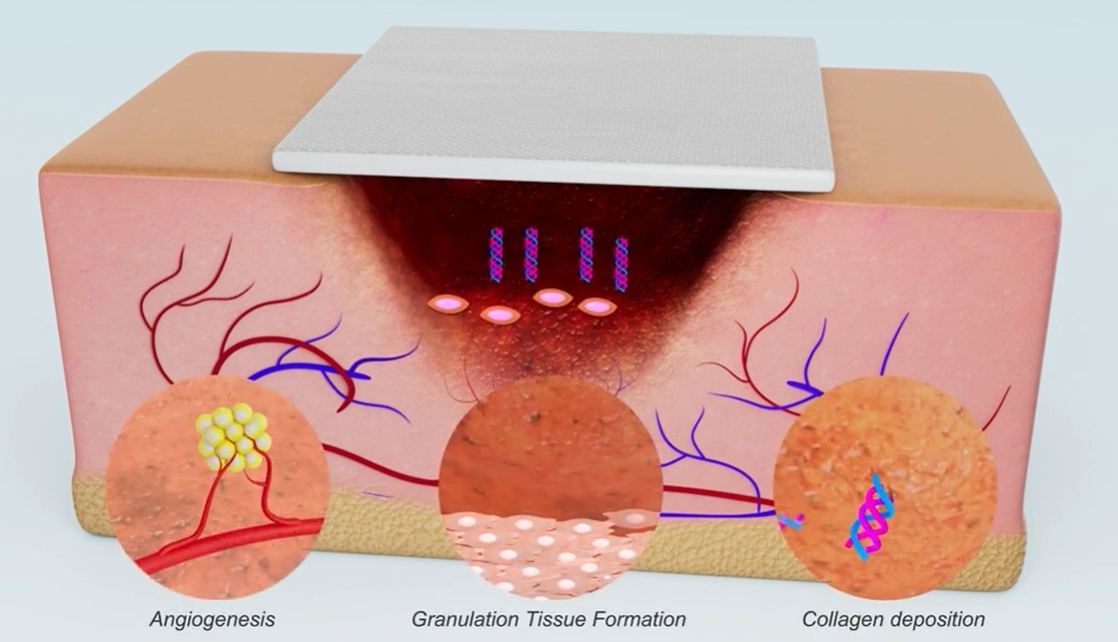
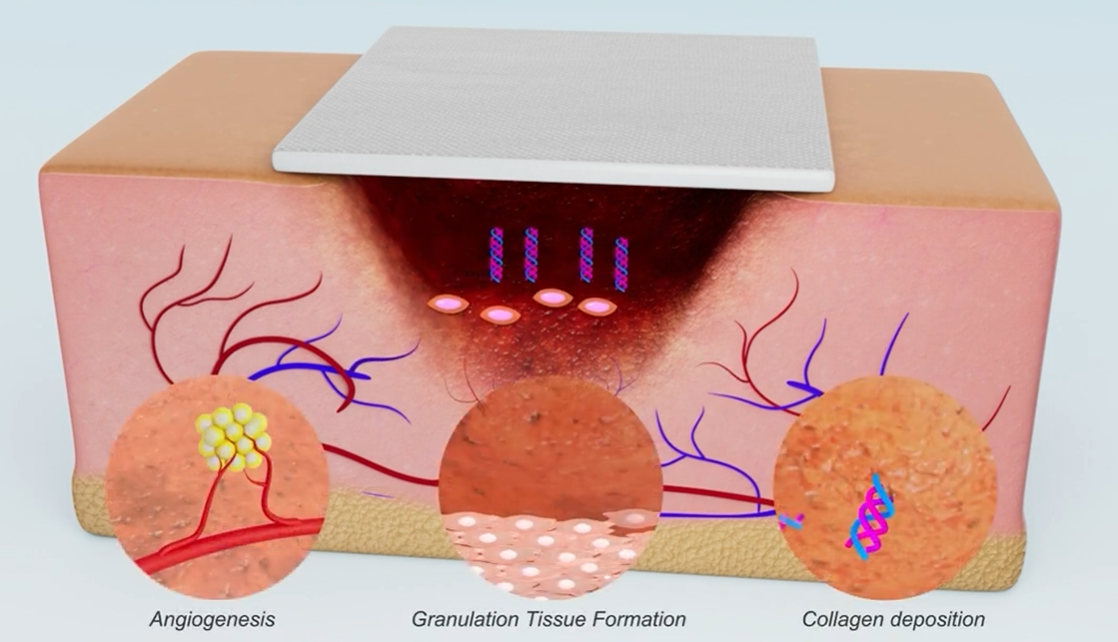
To illustrate what I mean, consider this wound healing animation we produced for Seriderm, a wound care innovator.
Wound healing is a process that unfolds across days and involves a precise choreography of cellular events — hemostasis, inflammation, proliferation, and remodelling. Each phase has a distinct visual signature: the fibrin clot forming, neutrophil infiltration, macrophage activity, fibroblast migration, collagen deposition, angiogenesis. Getting this wrong undermines the entire clinical argument the brand is trying to make.
This animation worked because the team behind it understood the science before they touched the software. They knew which cells appear when, what the extracellular matrix looks like at each stage, and how to make the sequence feel progressive and logical rather than arbitrarily dramatic. The result is content that a wound care specialist, a hospital procurement officer, or a regulatory reviewer can watch and trust.
That level of credibility is the entire value proposition. It cannot be faked, and it cannot be outsourced to any animation studio in Pune that doesn’t have the domain knowledge.
The AI Question: Fast, But Not Ready
No conversation about animation in 2026 would be complete without addressing the AI elephant in the room. I’ve had clients ask whether AI tools can now generate medical animations — cutting out the need for a specialist studio altogether.
The short answer is no. And the longer answer is illuminating.
Ghost Productions, one of the world’s leading 3D medical animation studios, recently ran a rigorous test pitting seven of today’s best AI image generators — including Midjourney, Sora, Grok, Flux 2, and their own domain-trained model — against real medical illustration benchmarks. Their findings were unambiguous: none of these models is ready for serious medical accuracy.
The core problem isn’t the quality of the rendering. Some of the AI outputs looked impressive at a glance. The problem is that AI tools are trained on data, and medically accurate imagery represents a tiny fraction of the internet’s visual content compared to the billions of images that train models toward aesthetic appeal rather than anatomical correctness. As Ghost’s team noted, the models have been rated millions of times on whether the output looks appealing — not on whether a valve seats correctly in the aortic annulus.
The result is that AI can generate something that reads as medical-looking to a lay audience, while being riddled with errors that would immediately disqualify it in any clinical context. Misplaced anatomical structures. Biologically impossible cellular sequences. Labels that are spelled wrong or placed illogically. A transcatheter valve with geometry that could not physically function.
For consumer products or abstract marketing content, this might not matter. For a 3D medical animation company in India producing content that will be reviewed by surgeons, compliance teams, or KOLs — it matters enormously.
What AI can do is assist with concepting, rough mood boards, background restyling, and aesthetic exploration. The best medical animation studios in Pune use it as a workflow accelerator, not a replacement for domain expertise. Human oversight, scientific validation, and clinical review remain non-negotiable in this space. That’s not a limitation that will disappear soon, because the problem isn’t computational power — it’s training data quality and the scarcity of expert graders who can validate medically accurate output at scale.
Why Location and Niche Both Matter
There is a secondary consideration that Indian pharma, medtech, and healthcare brands often overlook: the value of working with a 3D medical animation studio in Pune or another Indian hub isn’t just about cost. It’s about communication bandwidth.
When you’re iterating on a surgical procedure animation at 11pm before a conference deadline, you want a studio that’s in your time zone, understands your regulatory environment, and can get on a call without scheduling across a twelve-hour gap. The proximity advantage is real — but it’s compounded when the studio also brings genuine scientific depth.
A 3D medical animation company in Pune that works specifically in the life sciences sector brings together geographic convenience and clinical fluency. That combination is rare globally and increasingly available domestically.
More broadly, the Indian medtech and pharma ecosystem is producing world-class innovation at a remarkable pace. The content that represents these innovations — to international investors, global hospital networks, and regulatory bodies in the US and EU — needs to be held to the same standard as the science itself. Generic animation, however polished, doesn’t do that job.
What to Look for in a Medical Animation Company in India
If you’re evaluating a 3D medical animation company in India for your brand, here are the questions worth asking:
Does the team have direct scientific or clinical background? Not just animators who’ve read some papers — people who understand biological mechanisms, device engineering, or pharmacology from first principles. The brief can only take you so far.
Can they show you medically reviewed work? Portfolio pieces that have been through KOL review, regulatory submission, or clinical training programmes carry a different weight than concept animations made speculatively.
How do they handle scientific accuracy disputes? The best studios have a review process. They welcome pushback from medical advisors and have a method for resolving conflicts between visual appeal and biological correctness.
Are they domain-specific? A studio that does medical animation among ten other animation types will always be slower to upskill on a new therapeutic area than one whose entire practice is built around life sciences.
The medical animation space in India is growing quickly, and not all studios that carry the label deserve it. The difference between a genuinely specialist 3D medical animation studio in India and a generalist with a healthcare page on their website is visible the moment a clinician watches the output.
Conclusion
Medical animation isn’t a creative piece but a scientific communication tool. And like any precision instrument, it needs to be made by people who understand what it’s for.
A great 3D medical animation company in India doesn’t just make things look good. It makes complex biological and clinical realities legible to the people who matter most — investors who need to believe in the science, clinicians who need to trust the device, patients who need to understand their treatment.
That requires a very specific intersection of creative skill, scientific fluency, and relentless attention to accuracy. It’s not something AI can replicate today, and it’s not something a generalist animation studio can approximate through goodwill alone.
If the science behind your product is strong, the animation that represents it should be too.
TechSampark is a 3D medical animation studio based in Pune, built by engineers-turned-marketers who bring rare scientific rigour to every frame — combining deep technical knowledge of healthcare and life sciences with the storytelling instinct of seasoned content strategists. Our team comprises engineers, biotechnologists, healthcare professionals, medical writers, and experienced medical animators who understand that in this field, getting it right isn’t optional. If your science is ready to be seen, we’re ready to show it. Let’s collaborate to create a medically accurate and visually crisp 3d medical animation!